Magic season, p.1
Magic Season, page 1


“A beautiful, poignant and, yes, magical memoir that captures the tough and tender bonds between father and son. This book will captivate readers from start to finish.”
—John Searles, New York Times bestselling author of Help for the Haunted and Her Last Affair
“Wade Rouse’s masterful memoir about coming out and coming to grips with his cantankerous, conservative father over a shared love of baseball is a pitch-perfect blend of storytelling, emotional discovery, and survival humor. Home run!”
—Meredith May, author of The Honey Bus and Loving Edie
“This moving memoir teaches not only truths about the difficulty of masculine healing but also the joy of life a man knows once he attains it.”
—Daniel Black, author of Don’t Cry for Me
“Honest, authentic, heartbreaking and healing. Magic Season explores, in such a poignant yet hopeful way, the complicated family relationships that break us and make us. I devoured it in one day.”
—Jenny Lawson, #1 New York Times bestselling author
“Eloquent, profound, and as funny as it is heartbreaking, Magic Season is a poignant reminder that those of us who’ve had rocky upbringings can go down to our tenderest parts and truly be ourselves, open to love. This glorious memoir hits it out of the park.”
—Caroline Leavitt, New York Times bestselling author of With or Without You
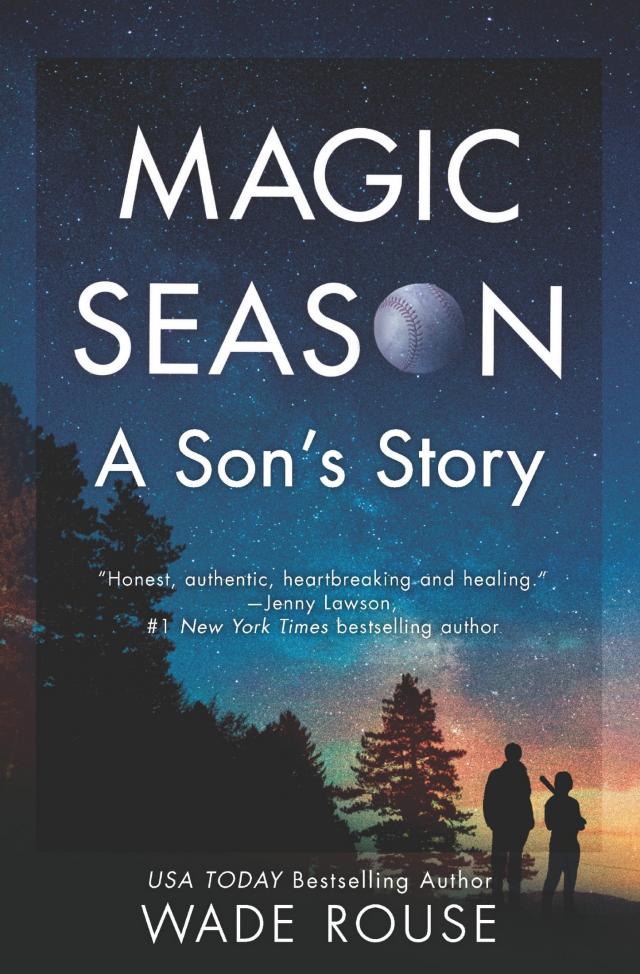
MAGIC SEASON
A Son’s Story
WADE ROUSE
Wade Rouse is a popular award-winning memoirist and internationally bestselling author of thirteen books, which have been translated into twenty languages and selected as Today show Must-Reads, Indie Next Picks and Michigan Notable Books. Rouse writes fiction under his grandma’s name, Viola Shipman, to honor the working-poor Ozarks woman whose memory inspires his writing. He lives in Michigan and California, and hosts Wine & Words with Wade, a literary happy hour, every Thursday.
For my father
For the St. Louis Cardinals
And for every sports fan, father and son, parent and child, and soul who believes in hope, forgiveness and a win tomorrow
Contents
Quote
The Pregame
1st Inning
October 2015
Spring 1972
October 2015
2nd Inning
October 2015
October 2015
3rd Inning
October 2015
Summer 1970
October 2015
4th Inning
October 2015
October 2015
5th Inning
October 2015
The 1970s and 1980s
Summer 2009
October 2015
6th Inning
October 2015
December 1983
October 2015
October 2011
October 2015
7th Inning
October 2015
The 1970s–1990s
October 2015
Spring 1998
Summer 2010
7th Inning Stretch
October 2015
Fall 1976
October 2015
8th Inning
October 2015
March 1965
1977
November 2012
October 2015
9th Inning
October 2015
Summer 2001
October 2015
Bottom of the 9th
Spring 2019
Acknowledgments
“Love is the most important thing in the world,
but baseball is pretty good, too.”
—Yogi Berra
The Pregame
The game of baseball has been criticized in recent years for being too long. Too many substitutes, too many pitching changes, too many retreats from the batter’s box, too many meetings on the mound, too many commercials. But it’s actually a short journey from the first inning to the ninth, a couple of hours, and the outcome is often determined by little moments made from inning to inning, tiny decisions that decide the final score.
It is the same in life.
The last Cardinals game I watched with my dying father was filled with great hope and missed opportunities, just like life and the sport itself.
Our beloved St. Louis Cardinals were playing the hated Chicago Cubs in the National League Division Series. The Cards were down to their final game; my dad was down to his final weeks. We were both down to our final innings together.
Ironically, our relationship was a lot like the Cards-Cubs rivalry: intense, heated, bitter, filled with history and yet tinged with incredible admiration—and disgust—for the opponent.
We had little in common besides baseball. My father was an Ozarks man, born and bred, and I was a city boy, a liberal turncoat who up and ran from the place he was raised. He was an engineer; logic overruled emotion. I was a writer. You get the picture.
But I had a lot of the Ozarks in me, too, which can make a man as hard and unforgiving as the rocky terrain.
What did I have to forgive my father for?
How long do you have?
And yet I loved him.
So deeply, despite all he did and didn’t do for me, that my heart still flutters and moves all about my chest to this day, just like a good knuckleball.
You will likely ask why I stuck by my father, or even gave him a second, third or fourth chance at all. So, I ask you this: Why do you stick by your favorite team, season after miserable season? It’s because, no matter how pessimistic we’ve grown, no matter what we’ve long endured, we always believe that a miracle can happen, that a magical season will occur and obliterate all the bad memories that came before. A true fan believes in his heart that even a terrible team can turn into a great one.
Life, like being a baseball fan, relies on two things: hope and forgiveness.
The only thing I ever wanted was my father’s approval. And I worked for it, yearned for it, through that final game, until his last breath.
Everything divided us. Except baseball.
Which was why I would take a seat next to him every time he patted the couch and the Cardinals were playing. I truly believed that, by the end of our final season together and that last game, the score would be different.
All I really wanted to do during our last game together was tell my father I loved him and forgave him. And all I wanted to hear was how much he loved me and how proud he was of me.
But, again, life and baseball really boil down to the simplest of things.
And those seemingly simple things would prove as difficult to come by as a big hit for the Cardinals in our last game together.
1st Inning
GAME 4
St. Louis Cardinals-Chicago Cubs
National League Division Series
“Anything Can Happen”
October 2015
Before the start of every baseball game I ever watched with my dad—as soon as the National Anthem had ended and his hand was off his heart—he would say the same thing: “Anything can happen.”
It was an astonishing statement of optimism from my eternally pessimistic father, who had pretty much hated the state of the world since his 1950s Happy Days life ended. But when the players took the field, the pitcher was warming up, the fans were buzzing, the sky was blue, the beer was cold and the game was scoreless, Ted Rouse was plumb near Walt Disney.
“Anything can happen.”
“That’s right,” I say.
He is wearing the Cards cap I gave him after they won the 2011 World Series. It is still in pristine shape. The bill is unbroken and the shiny stickers are still attached, and my dying father looks as if he’s trying to emulate today’s urban youth.
I watch his head bob, and then he is asleep.
Suddenly, the Wrigley fans roar, and my dad jerks awake.
“Screw the Cubbies!” he yells as best he can at the TV.
He looks at me and nods as if to say, I’ve still got enough life to roar back, too, son.
We are sitting in the living room of the tiny home I had built for my nearly eighty-year-old father a few years ago. It was his wish to die at home. He hated his short-lived stint in assisted living.
“Doesn’t play well with others,” the home’s administrator had told me as if my father was in preschool.
“I don’t either,” I told her.
At the time, assisted living was the only temporary solution. My father had been in a downward spiral since my mom died of cancer in 2009. His drinking had escalated, his health had declined, and he’d somehow turned into Ellen Burstyn in Requiem for a Dream, collecting Oxy from doctors all over the Ozarks. I’d found him nearly dead on a surprise visit, lying soiled in his own bed. While recovering in the hospital, my father not only detoxed but was tested for dementia. When the doctor asked him to draw a baseball diamond and he couldn’t, I had to sprint to the hallway to hide my tears.
“You can’t stay at home,” I told him. “The bedroom and bath are upstairs, there’s no railing on the stairway, the house is too big.”
He refused to move near me, to leave the little town in which he’d lived his whole life. My father hated change. I was the king of surprises. I always tease
“At least people will know where to find me,” he’d say. “You, on the other hand...”
I look over at my father. His head is bobbing again, the Cards cap pecking the air like a duck’s bill.
“I just want to die at home,” my father told me in assisted living. “Die with dignity.”
I remember a pain knifing through my heart at that moment because I knew that would be exactly what I’d want, too, at the end of my life.
So I helped him build a small, wheelchair-accessible home on the lot where my grandma and grampa had lived, and died. It was a big parcel of land set high on a hill that overlooked the main street into our tiny town as well as the rolling Ozarks hills leading out of it. From this vantage, my dad could see everything. It only seemed fitting that he could watch the town die as he did.
“We’re both survivors, boy,” my dad says to me out of the blue as the first inning of Game 4 is about to start. I lean closer to hear him. “That can be a good thing or a bad thing.”
“Which is it, Dad?” I ask. “Good or bad?”
He smiles.
“Not up to me to decide anymore,” he says. “What do you think?”
I look at him. “I don’t know.” I stop. “I think it’s a good thing. Surviving means you’ve been tested. You’re still alive for a reason.”
A smile crosses his face. He shakes his head.
“You’ve always been an honest sum bitch,” he says. “Too honest for your own good.”
“Better to lie?” I ask.
“Sometimes,” he says. “Makes life easier.”
“For whom?” I ask.
“Turn the game up.”
We listen to the National Anthem in silence.
Out of nowhere, my father reaches out and taps my arm. There are tears in his eyes.
“What is it, Dad?” I ask. “Are you okay?”
“No,” he says. “I’m dying.” He looks at me. “I don’t know what’s worse. Dying or living long enough to see the Cards lose to the Cubs.”
He’s always been funny. Something we have in common.
“They haven’t lost yet,” I say.
The game starts, but I can feel my father staring at me instead of the TV.
“Why are you still here?” he finally asks.
I know this is a bigger question than it sounds on the surface. He doesn’t mean why did I extend my stay with him to watch this game but, literally, why am I still a part of his life?
“Because I love you.”
I don’t mean it to, but this comes out sounding like a question.
My father smiles.
Why am I still here? I think. Guilt? Obligation?
I glance at a photo on the wall of my family from my youth, the four of us in the old Rouse House, before death nearly swallowed my family whole as if the taste of grief was the most delicious thing in the world. My mother is looking at me in the photo in an adoring fashion, her hand in motion as if she’s going to draw me closer to her. I hate platitudes, like when everyone says that dead people are saints, but my mother was as close to one as I will ever know. She was a hospice nurse who actually got what life was all about, what it meant to be here on this journey she used to call “as short as one blink of God’s eye.”
I think of my dad’s question.
Why am I still here? For me, it comes down to the matter of being a good person. I look at my father and then at my mother. No, scratch that. A better person.
“My God,” he says a second later as if he’s been watching me. “You loved your mother. I’ve never seen two people love each other more in my life.”
He makes it sound like a bad thing.
I stare at my father, as his eyes blink—once, twice—and then his head lolls to the side, and he is asleep again. How can he be both so lucid and so loopy at the same time?
I watch him snore. He is a very old man now, weak, so unlike the man I knew whose anger and rigidity and volatility and threats kept me quiet for too long.
“Are you a real man?” my father always asked. “Do you know what it’s like to be a real man?”
What is a “real” man anyway? I always wondered.
And did I become the man I am today because of my father, or in spite of my father?
Spring 1972
“Anything can happen.”
We both knew it was a lie, but—in the Ozarks—a dad had to teach his son to play ball, and a boy had to play ball. Period.
It was like baling hay, shooting a rabbit or gutting a fish. An Ozarks boy had to learn to do such things.
I wasn’t your typical Ozarks boy. I would never be your stereotypical man.
I cried gutting my first fish, I puked shooting my first rabbit and I quit baling hay after my skin ripped, my shoulders blistered, and I was caught eyeing all the shirtless boys whose tanned torsos were drenched in sweat.
Baseball I couldn’t get out of so easily.
“Why don’t you go play ball with the other kids?” my dad would always ask me.
But we lived outside of town, on a dirt road in the woods, miles away from friends. Not that any of that would have mattered anyway. I preferred to be lost in a book, writing in my journal or going to the library. I preferred the kitchen over the playground, baking cookies with my grandma over kickball with schoolkids, wearing ascots and bow ties over overalls and sports uniforms.
None of this sat well with my father, who’d grown up a virtual Little Rascal, crawling in ditches, rummaging in trash cans, playing stick ball in the street. My father was a little man with a big presence. Born a tadpole, Ted Rouse never grew to be more than five foot five and a buck forty when wet. He tried to play football in high school as if he were twice that big, though, before breaking bones more easily than he broke bread every Sunday. He eventually settled on tennis, where he still threw himself around the court with abandon. He didn’t learn. He went on to box in college and was always showing off the bend in his oft-broken nose as a point of pride.
If an illustrator were to have drawn my father as a character in a comic strip—the old-school kind that used to appear in color in the Sunday paper when he and I were kids, the ones I traced onto Play-Doh—he would have been a mix of Li’l Abner and Andy Capp. He deemed himself a paragon of innocence in a dark and cynical world, his excuse and escape drinking and having fun.
When my dad asked me to play T-ball, I refused. When he wanted me to play flag football, I said no. When he drove me to play catch with some of the guys he hunted with, I trembled so terribly, one of the hunters said I reminded him of a scared rabbit in the crosshairs of his scope.
“Those are the rabbits that need to be shot,” he said to me. “They ain’t gonna make it long in the world anyway.”
For me not to play sports was an affront, not only to our little town’s code of life but also to my father, his world and expectations. It mattered only that I fit the mold that had been created for Midwestern boys in rural America in the 1970s.
Why didn’t he force my brother, Todd, to play sports? Because Todd checked most of the other boxes on the rural father-son checklist: Avid hunter, with guns and bows. Tinkerer of engines. Tree climber. Mud-pie maker. Boot wearer. Skoal chewer.
So, without asking, my father arrived home one night to announce that he’d signed me up to play summer Little League. I was furious.
“You know I can’t play,” I protested.
“You’re not trying,” he said.
I begged my mom, who took my side on most things.
“Give it one more try,” she said. “Your father will teach you. Right, Ted?”
Quid pro quo before I even knew what that meant.
A gulp of his beer. A moment of silence. A nod.
My mother’s checkmate meant my father would be forced to spend time with me.
Most days, after the school bus would let me out, I would walk the mile home on our dirt road. I’d grab a snack—a Pop-Tart, a bowl of Count Chocula, a Little Debbie—and flip on the TV. I’d watch reruns of The Brady Bunch, Batman, Gilligan’s Island, I Dream of Jeannie and The Munsters until my father came home. He’d immediately grab a beer, two gloves and a baseball, flip off the TV and urge me into the backyard.